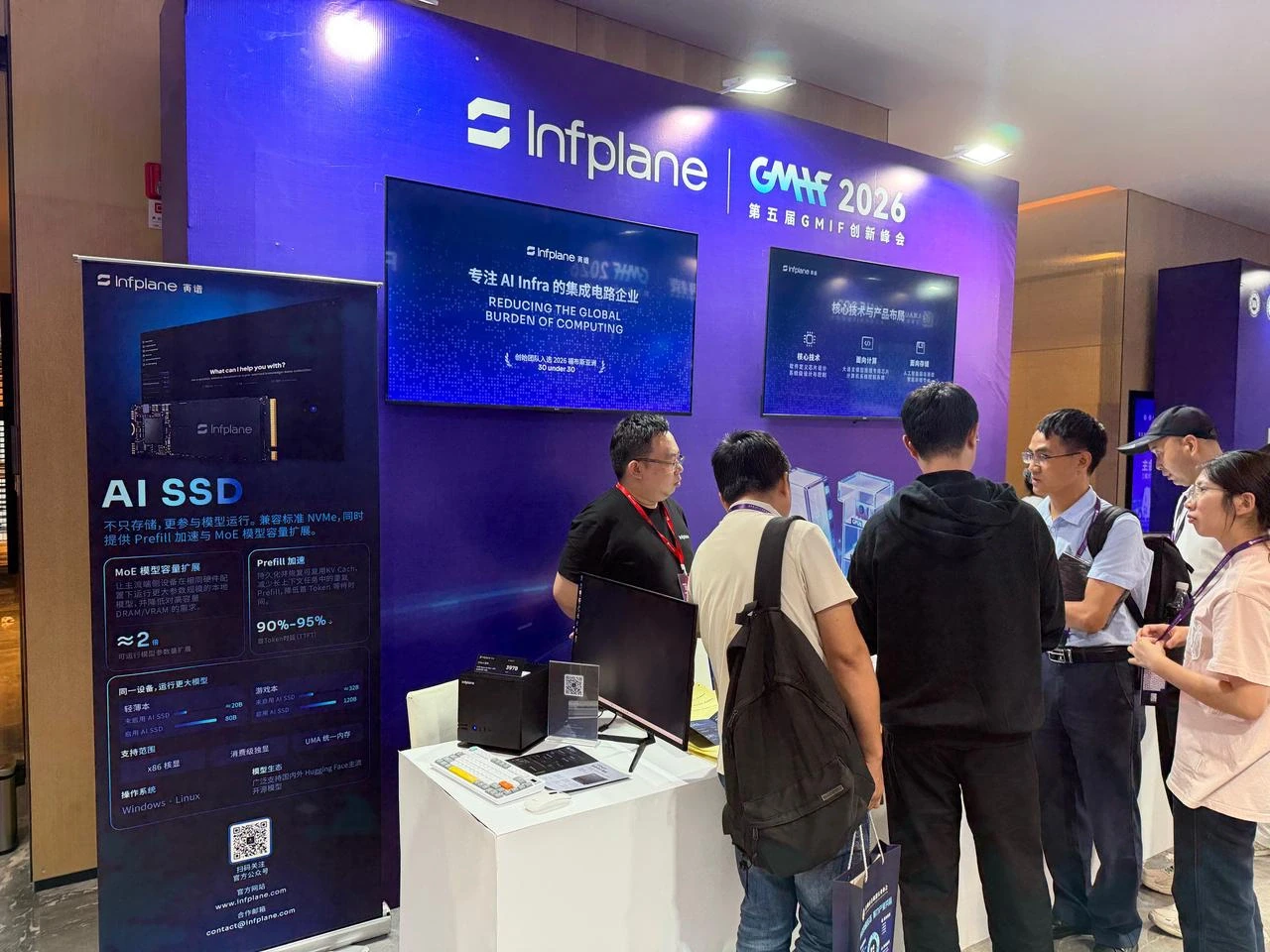
On September 23, 2026, the fifth GMIF 2026 Global Memory Innovation Forum was held in Shenzhen. Under the theme “AI Storage, Powering the Future,” the summit focused on the development of storage technologies and industry collaboration in the AI era. Infplane CTO Dr. Wei Xiong attended the event and delivered a presentation titled “How Storage Technologies Are Reshaping Hardware Architecture for Large Language Model Inference.” Focusing on storage bottlenecks in large language model (LLM) inference, emerging storage technologies, and hardware-software co-design, Xiong shared Infplane’s perspectives and technology roadmap for next-generation compute and storage architectures.
Following the presentation, Ye Jin, Deputy General Manager of the Storage Business Unit at Maxio, introduced the joint AI SSD solution developed by Maxio and Infplane, showcasing the two companies’ technical work in edge inference and compute-storage collaboration.
At the summit, the joint AI SSD solution developed by Infplane and Maxio received the “Outstanding Intelligent Storage Achievement Award” at the GMIF 2026 Annual Awards. Infplane also hosted an exhibition booth, providing attendees with an opportunity to learn more about the company’s technology directions and solutions.
Rethinking the Relationship Between Storage and Compute for Inference at Scale
As large language models move toward inference at scale, cost per Token, response speed, and energy efficiency have become important considerations in hardware architecture design. Models exhibit different compute and memory-access characteristics across different stages of inference, placing more nuanced requirements on how storage resources are organized.
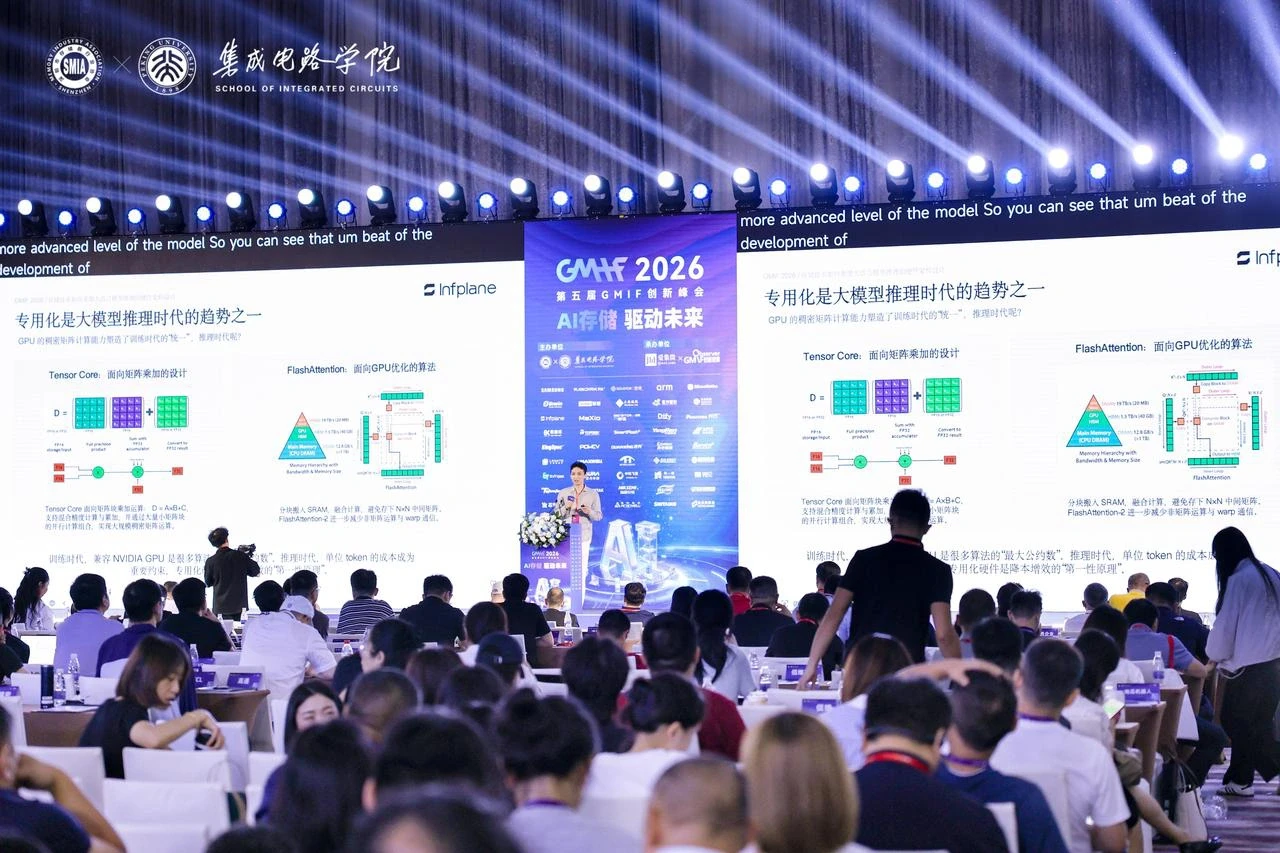
In his presentation, Xiong examined several typical bottlenecks. In small-batch Decode scenarios, Token-by-Token generation requires model weights to be read repeatedly, making data delivery speed a potential constraint on compute efficiency. MoE models activate only a subset of experts at a time, while the full set of parameters must still be stored, increasing capacity and scheduling pressure. Long-context and multi-turn interactions, meanwhile, drive continued growth in the size of the KV Cache, making cache placement, reuse, and management increasingly important. Together, these challenges point to a fundamental architectural question: how can storage and compute be co-designed around the way data is actually used?
The presentation proposed that storage capacity, bandwidth, and data movement costs should be treated as core considerations in inference hardware design, opening up opportunities to explore new ways of organizing compute enabled by advances in storage technology.
Exploring Emerging Storage Technologies and Next-Generation Compute and Storage Architectures
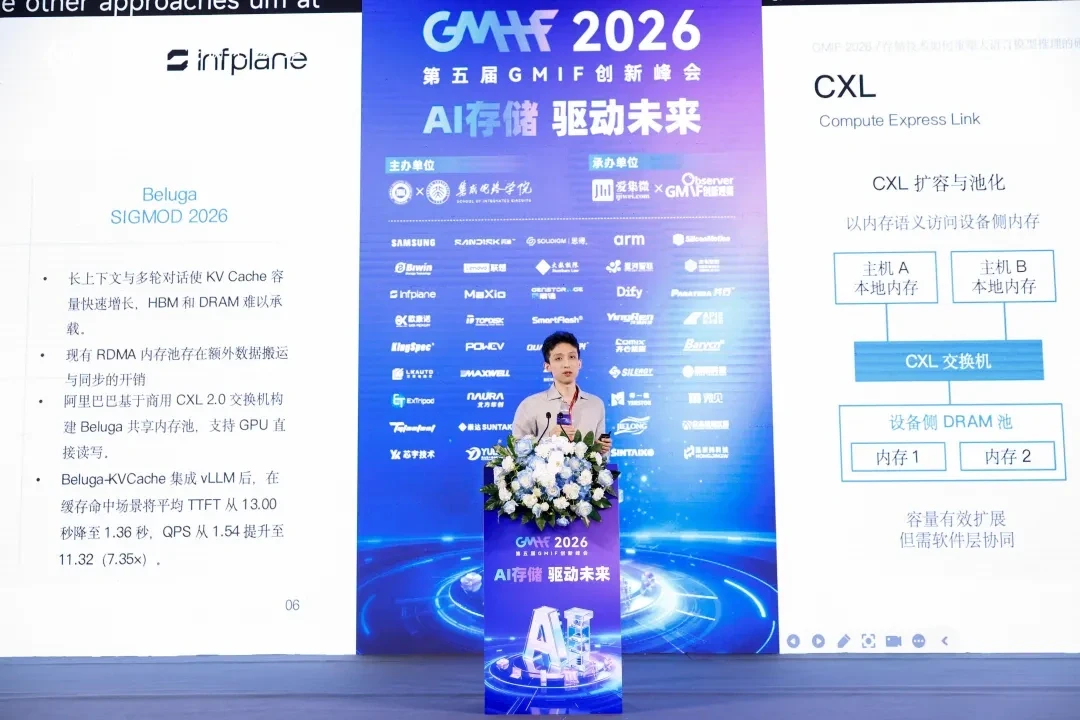
Addressing the new requirements that LLM inference places on storage capacity, data delivery efficiency, and compute organization, Xiong drew on Infplane’s software-defined hardware design approach to share research and perspectives on emerging technologies including CXL, high-bandwidth flash (HBF), near-memory computing, and in-memory computing. At the heart of these discussions was a common question: how can advances in storage technology be translated into greater efficiency in inference architectures based on the actual data requirements of models?
To address the capacity pressure created by the continued growth of model parameters and KV Cache, Xiong focused on the potential of CXL-based memory expansion and pooling, as well as lossless compression within controllers. In his analysis, capacity expansion needs to be co-designed with data tiering, access management, and inference scheduling in order to provide more flexible and cost-effective storage support for model execution. This also reflects Infplane’s system-level approach to storage technology: looking not only at the capacity and bandwidth that storage components can provide, but also at how those capabilities can be efficiently utilized by inference systems.
For high-bandwidth flash (HBF), Xiong further explored its potential role in inference architecture design. Drawing on relevant research, he analyzed how internal flash parallelism, data placement, and prefetching mechanisms can affect data delivery, emphasizing that the different read/write characteristics of model weights and KV Cache need to be fully considered in hardware design. This discussion aligns with Infplane’s technical work in inference data scheduling and hardware-software co-design, providing insights into the integration of emerging storage media with inference systems.
Addressing the data movement overhead associated with MoE expert weights, Xiong extended the discussion to near-memory computing and in-memory computing, exploring architectural approaches in which some weights remain on the storage side while corresponding computation is performed closer to the data. By replacing large-scale weight movement with the transfer of smaller activation values, such designs have the potential to alleviate interconnect bandwidth pressure between compute and storage. He also analyzed how expert workloads, compute precision, and communication overhead can influence architectural choices, reflecting Infplane’s in-depth thinking on the relationship between workload partitioning and data placement.
Through this presentation, Infplane demonstrated its research perspective on next-generation compute and storage architectures, as well as its foundational capabilities in connecting model requirements, storage technologies, and hardware design. These studies and technical assessments are helping Infplane build a stronger technology foundation for its continued exploration of new computing architectures for AI inference.
Building Technical Capabilities Through Software-Defined Hardware and System-Level Design
Underlying these explorations is Infplane’s technical expertise in software-defined chip design and system-level design and control. For AI infrastructure, Infplane conducts R&D on dedicated ASICs for LLM inference and computer system control, incorporating model execution, data scheduling, and hardware resource organization into an integrated design approach.
In his presentation, Xiong used different approaches to organizing inference systems around KV Cache and experts to illustrate how software can influence hardware design. Requirements for cache sharing and reuse can shape storage nodes and data transfer paths, while expert routing and scheduling can affect compute resource allocation, weight placement, and interconnect design.
This co-design methodology, starting from runtime requirements, provides a foundation for Infplane to connect technological innovation across compute and storage. Through continued research into storage hierarchies, prefetch scheduling, and compute placement, Infplane is further developing architectural design capabilities for future inference workloads while exploring ways to apply these technologies to specific systems and products.
Infplane and Maxio Present the AI SSD Solution
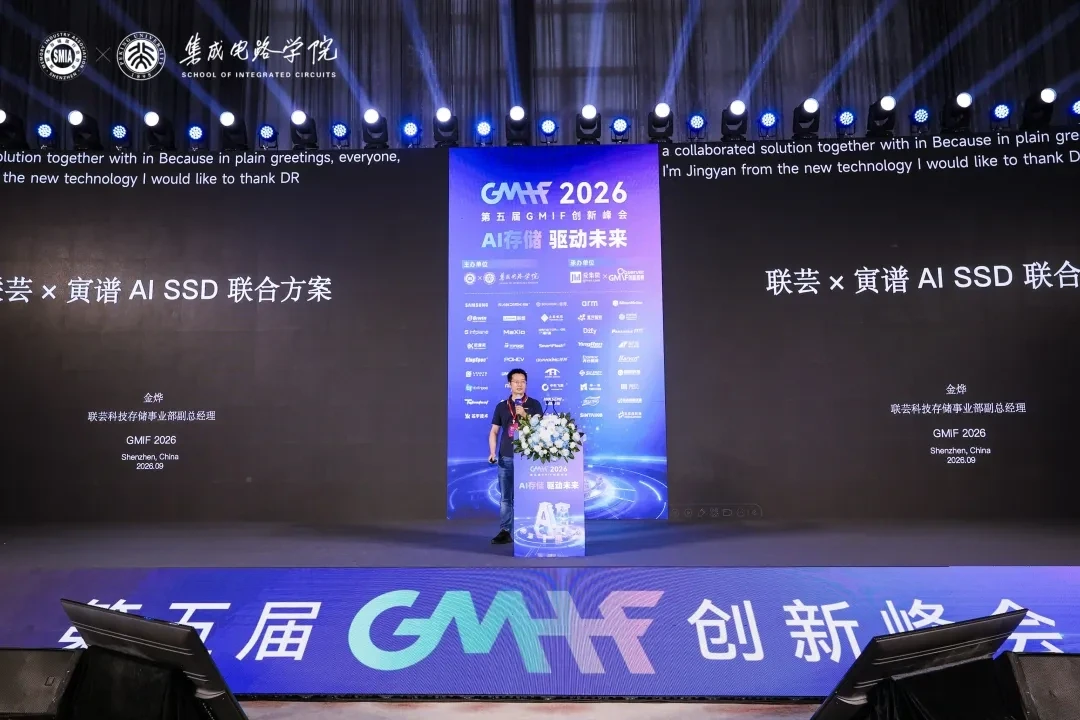
During the AI SSD technology presentation, Ye Jin, Deputy General Manager of the Storage Business Unit at Maxio, introduced the AI SSD technology jointly developed by Maxio and Infplane. Designed for LLM inference across edge and on-device scenarios, the solution leverages in-storage data processing to enable intelligent prefetching, parallel processing, and management of model weights, precision bits, and KV Cache. It is designed to alleviate capacity pressure on local DRAM and VRAM, improve inference data delivery efficiency, and enable local computing systems to support models several times larger than would otherwise be possible.
The solution reflects the technical expertise of Infplane and Maxio in near-memory computing, AI infrastructure, and computer systems. It represents a concrete example of how the two companies are combining their capabilities across compute and storage to advance practical technology deployment, while also demonstrating the strong relationship between the two teams and their commitment to long-term collaboration.
Infplane Receives the “Outstanding Intelligent Storage Achievement Award”
At the GMIF 2026 Annual Awards, Infplane received the “Outstanding Intelligent Storage Achievement Award,” recognizing the innovation and application value of the AI SSD technology jointly developed with Maxio. Designed around the requirements of AI inference and drawing on the two companies’ technical expertise in near-memory computing and storage, the solution enables KV Cache persistence, as well as the prefetching and intelligent tiering of hot and cold experts and precision bits in MoE models, helping alleviate capacity and data-access bottlenecks in edge and on-device inference. The award reflects Infplane’s technical expertise in inference data-flow research and near-memory computing, while also highlighting the innovative results of Infplane and Maxio’s collaboration in combining capabilities across compute and storage to provide more efficient local inference support for AI PCs, edge devices, and AI agent applications.
As LLM inference continues to expand from the cloud to edge and on-device environments, pressure on local DRAM and VRAM capacity is becoming increasingly significant. The joint AI SSD solution provides more efficient local inference support for AI clusters, AI servers, AI PCs, edge devices, and AI agent applications. Going forward, Infplane and Maxio will continue to deepen their collaboration around the storage requirements of AI inference, advancing innovation in compute-storage collaboration and developing more efficient and cost-effective compute and storage architecture solutions for next-generation AI infrastructure.